By Moriah Schranz
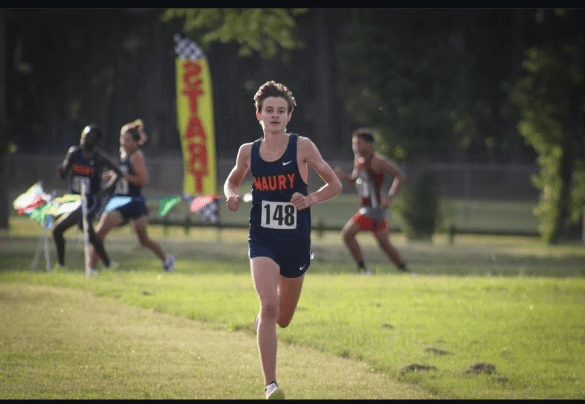
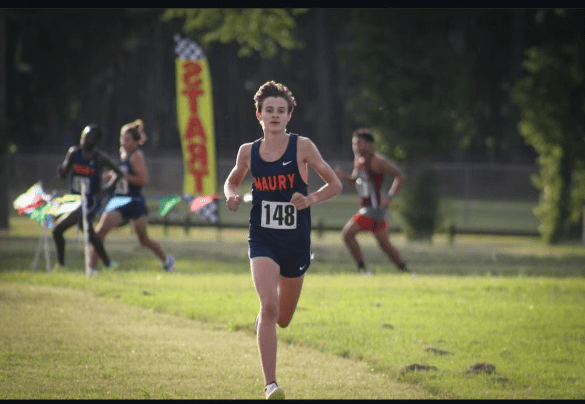
A fifteen minutes and 17 seconds 5K is unheard of at Maury High School, until now.
On Sept. 4, Mateo Canga, a junior at Maury High School, placed first in the Eastern District Meet #1, while also breaking the school record for the fastest five kilometers.
Canga finds inspiration from many people in his life, especially his parents. He says they have inspired him ”not just as an athlete but also as a student and well rounded individual.”
The Cangas also have running in their blood. Mateo’s mother walked onto the Princeton track and field team and his freshman brother is already displaying excellent times for Maury cross country.
Other than his family, Mateo finds inspiration from God and his coaches. He remembers the people that have helped him get to where he is.
The following has been edited for clarity:
MS: How did you get into cross country?
MC: My friend Cameron Sadr ran cross country. In middle school, we would run a fitness mile and he was impressed with me, so he convinced me to join the team. After freshman year, I realized I was pretty good, so I decided to run indoor track. I liked it a lot, so I then decided to run year round.
MS: You recently broke a school record, running a 15:17 5k. What kind of preparations allowed you to run that?
MC: The thing about running is you can’t decide like a week before you want to do it. This is something I have wanted to do for two years. I’ve always wanted to improve and run faster. Last year, I had an injury and got a new coach, so I really had to change things and see what was holding me back from being the best runner I can be. I think I’ve really made those changes and been consistent.
MS: You mentioned an injury. Can you talk a bit more about that?
MC: My sophomore year I got two stress fractures. This kept me from running for around six months. It was hard not running because we had some really great seniors and also the social part. I love my cross country teammates and it sucked not being with them. That was a huge struggle but it helped me reflect and come back with better habits. I think I am a better runner now than how I would have been without the injury.
MS: How did you recover from that?
MC: It took twelve weeks off all exercise. Six weeks on crutches, six weeks on a boot and then I was able to start doing some low impact stuff. I did some cross training and swimming which was hard because I hate swimming. I slowly progressed into running from every few days until now, where I can run every day.
MS: Did you struggle keeping yourself motivated during that time?
MC: I was not motivated to do the activities but I wanted to run. I hated going in the pool every day, but I love running so I just tried to think about why I’m doing it. I would try and take a step back and remember what this was for.
MS: What are you doing to prevent future injuries?
MC: I’m really focusing on the recovery part. This is not just after running but also sleeping 8-10 hours every day, eating quality stuff and intervention specific to what I run.
MS: What keeps you motivated now?
MC: My love for the sport keeps me motivated and also being the best runner I can be. There are some things that are out of my control but I do what I can.
MS: You do track along with cross country. What are the main differences in those environments for you?
MC: I think cross country is a lot more team related. Although for both sports your score is added up at the end, with cross country being distance runners and only one race for girls and one race for guys, you work more together. Track is more individual because it’s all different lengths and the events are separate. I love cross country and the environment. Plus, it comes a little easier to me. Track needs footspeed, which doesn’t come as naturally to me, for short distances.
MS: Is the training different?
MC: It’s not very different. When you get more advanced in college you can see bigger differences, but for high school, it’s similar workouts just tweaked. I usually do tempo workouts and race workouts. For cross country, it will be a 5K. While for track, it will be whatever I’m running there.
MS: What are your recoveries like for your big races?
MC: I try to have high protein things right after I run. After my injury, I really focused on fueling and eating good proteins and carbs. Usually after I run I have a protein shake or bar so my body recovers. I also try to sleep well by getting in my hours of rest and getting off my phone an hour before bed so I am relaxed. That’s hard during the school year but I try to do work on the computer first, and then annotations or paper work closer to bed. It’s hard to get off the phone especially when the groupchat is buzzing and there is a game, but I remember why I do this. I don’t always want to go to bed early on the weekends so I can wake up early to run before it gets hot, but it’s what’s needed. My coach makes sure my distances are the right volume and it’s nice having someone tell me that.
MS: How do you manage school through all of this?
MC: Running is a little bit easier of a technique compared to basketball for example because there is no waking up at 4am to perfect muscle memory. My practices are around two hours, but I’m not running the whole time. Much of it is preparing my body for the high intensity and recovering after. It is definitely a struggle and the phone makes it harder, but it’s important to stay focused. I also utilize the weekends to do work. On a few days I do double workouts and I sometimes have to sacrifice sleep or work, which is hard. I also try to get ahead and do as much work on weekends so that on Tuesdays and Fridays I have cushion when I do double workouts. It is probably something I’ll have to work and focus on for the rest of my student athlete career.
MS: What are your next big goals?
MC: I want to pursue running at the divisional level. It is also important for me to run at a school with good academics. I don’t want to be a professional runner as of now because only the top one percent can live a comfortable life with their careers. I think there are other things I can give to the world, and I want to get a degree along with what I give on the track.
MS: Have you been talking to schools about this?
MC: The Naval Academy has reached out to me and we have talked, [though] I’m surprised they reached out this early. I think that as the year goes on I’ll get more opportunities and as long as I continue to do what I’m doing, I’ll be pretty set.
 The Commodore Chronicle