By Moriah Schranz
As students walked through the door of Maury High School following their winter break, they were met with the implementation of Governor Youngkins cell phone policy.
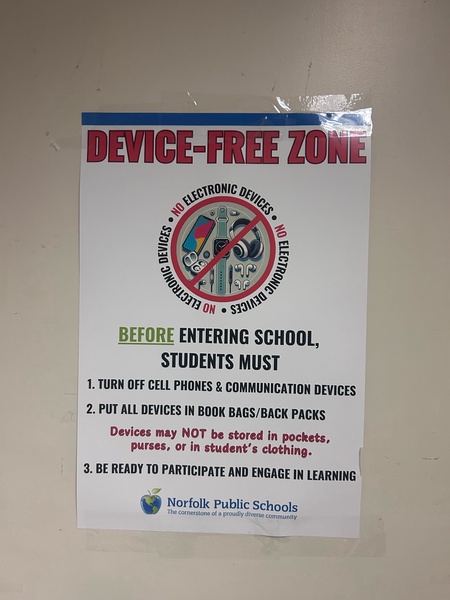
Students are heavily reminded of this rule, for it is repeated every morning on the announcements, the start of lunch and in many posters across the hallways.
On January 1, 2025, this policy became mandatory for all schools in Virginia. It states that bell to bell, meaning the start and end of the school day, cell phones are prohibited.
While cell phones may be banned, they are still apparent throughout the school.
Many students claim that they still see phones throughout the day. They are empathetic to teachers and security for being instructed to such a difficult task.
Junior Mateo Canga believes that because students are not allowed to have phones, they are even more keen to use them. Teenagers like to be rebellious, and placing a rule as controversial as banning cellular devices can backfire on administration.
Junior Daniel Sun believes that the cell phone policy hurts students. He says that he and many other students use their phones for school related things such as taking notes or pictures of assignments. He points out that the policy bans not only phones, but all personal devices. This includes computers, so students are forced to use school-administered chromebooks. These chromebooks are not automatically signed in and can take much longer to access class work compared to a personal device.

This aspect of the policy contradicts previous policies because during the 2023-24 school year, teachers and faculty encouraged students to bring personal computers because of a shortage of chromebooks.
Teachers see this issue as well. English teacher Mrs. Marston expressed her concern with the policy.
“I read The Anxious Generation and absolutely am for the detachment of phones in school,” said Marston. “They cannot be party to education. However, when it comes to the implementation of something so vast and large, every detail needs to be worked out. I think that’s what leads this to be nearly unenforceable because to do a full ban would require an immense amount of security that we don’t have. In my classroom, it is 100 percent possible, but in the hallways, I don’t see a way unless every single teacher asks every single student to put their devices away.”
Some students understand the need for the policy. Senior Alex Hallberg says he continuously sees new research on the negative effects cell phones have on learning. He hypothesized that cell phones may be altogether banned from entering school if the policy continues to be broken.
“The school may just get bags that students have to put their phones in to avoid the disruption,” said Hallberg.
While many students find the current policy somewhat moderate, many are angered by the fact that phones are not allowed during lunch. The school has responded by purchasing board games, and promoting cell-phone free activities.
Junior Tucker McGrady said he enjoys the boardgames. He went as far as bringing poker chips and cards to school so that he could play Texas Hold’em during downtime.
“I like games when I have lunch with my friends,” said McGrady. “But on even days, I don’t have friends in my lunch [wave]. That is when I wish I could be on my phone.”
During class time, Sophomore Colin Moorehouse believes that the cell phone ban only creates more disruption.
“When phones were allowed, disruptive students would just sit on their phones and not do work,” said Moorehouse. “Now that these students don’t have phones, they instead disrupt learning for everyone.”
Whether or not the policy is liked varies upon student or teacher, but among them there is a unanimous agreement that the policy needs to be tweaked to work.
 The Commodore Chronicle