by Moriah Schranz
As someone who usually brings lunch from home, I initially had a hard time relating to the criticism over school lunch. When thinking back on the few times I have gotten school lunch, I was reminded of the time my sophomore year when one of the lunch ladies interrogated me. She asked if this was my first time in line. I reassured her that it was, yet she insisted I had gotten lunch already that day. At the end of our back and forth, she said, “You must have a twin then because I swear I saw you in line already.” Finally, she gave me a plate.

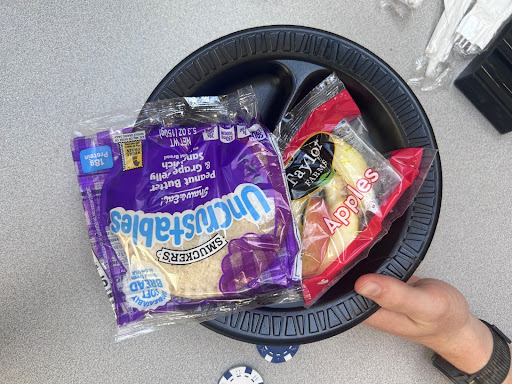
When asking students about how the food is at Maury High School, I was faced with usual and unusual responses. As I hypothesized, students complained that the food tastes bad. In addition to this, I was also met with criticism about the portion sizes.
Tucker McGrady, a junior at Maury, complained about the amount of food given to him at lunch. He was frustrated that they don’t give him enough food for a full meal, and that he was not allowed to ask for more.

“After a long day of learning, it’s so annoying that I’m given a few breadsticks and a fruit cup and told it is a meal,” he said.
Lisa Winters, Senior Director of School Nutrition for Norfolk Public Schools passionately shared the free lunch policy NPS has.
“Last year, NPS Department of School Nutrition served nearly 6.4 million no cost meals to students and children ages 18 and under. Norfolk Public Schools began offering meals free to all students in March of 2020, as a result of temporary, COVID-related changes to USDA Meal Programs. We were able to continue in subsequent years by fully utilizing the Community Eligibility Provision (CEP) of the National School Lunch Program (district-wide). We also operate other federal nutrition programs.”
She suggests that the results from transitioning into free meals was mostly positive.
One of the main benefits Winters identified was the reduced wait time in line with the removal of pin IDs, and the elimination of lunch debt.
While one may speculate that the small portions are a result of the free lunch program, this is not the case. Portion sizes are prescribed based on the nutritional needs of adolescents, per age group, as determined by scientists, dieticians, and medical professionals. These come from the National School Lunch Program Meal Pattern from the US Food and Nutrition Service.
Students also criticize the fact that they are forced to take food that they don’t want to eat, just for the sake of the cafeteria worker to check a box. They tell students to take a fruit and vegetable, and if the students don’t want it, they can throw it away. Unfortunately, this leads to food waste.
The Food and Nutrition Service has a program called Offer Versus Serve. This program claims to have a goal of reducing food waste by allowing students to choose the foods they want to eat. It claims to have benefits such as increasing the speed of lunch lines and reducing overall food costs.

Although in this program students have a choice in their food, they are still required to take three out of five of the food components: vegetables, fruits, grains, meat, meat alternatives, and milk.
These rules may be ignored at times, since students say that they can get away with not taking a vegetable they don’t want. This fact does present a limitation to the consensus about portion sizes, for the lunch program cannot be blamed if a student doesn’t take every food item they are given the opportunity to have.
Whether NPS agrees with these rules, they are required to obligate them. If they do not comply with meal pattern requirements, they would not be eligible to participate in the USDA programs. Without these programs, NPS wouldn’t receive any funding, meaning they would have to charge each student for the total cost of producing each meal.
Whether it’s a normal-sized meal or just a pair of breadsticks, the portion sizes and food quality in the cafeteria varies greatly. Hopefully we will see consistency and improvement in the future.
 The Commodore Chronicle